The Italian Junkyard

Thoughts, ideas, criticism about cars. Interesting news and facts from the world of the automobile. Events in Italy and Modena. What you can find elsewhere, filtered through the eyes of a discerning enthusiast. Design, style, everything on the chopping block. Nobody is safe anymore.

Showing posts with label 2 Italian Cents. Show all posts

Tuesday, February 10, 2015

Spada Vetture Sport Codatronca TS: a tale of the lost art of aerodynamics, proportions and taste


I mentioned what present day Viotti is doing with its renewed shop, and you might have recognized under the wrap a familiar shape, the Bertone Mantide. No, I'm not going to talk about all over again, it was more than five years ago and even if the little to inexistent success that car has seems unfair to me, it had its time both here and all over the world.

So what's the other connection with Viotti? The Mantide was not the only Corvette-based project they had something to do with, and even if the incriminating picture has been long pulled off Viotti's website, quite some evidences were pointing in the, pun intended, pointy direction of the Spada Vetture Sport Codatronca TS. Such a long name might suggest something entirely different, but there might be some reasoning behind it.

White Spada Vetture Sport simply suggest that behind this venture is none other than Ercole Spada joining forces with his son Paolo Spada, the original concept was unveiled in 2007 under the SpadaConcept TS Codatronca moniker. I've no idea, and somewhat little interest into, what that was all about, but the focus here should be about the second part. Codatronca. Since it isn't even a proper word in Italian, it's hard to directly translate into English. You may refer to it as a fastback, or even as a shooting break, truth is coda-tronca means the tail of the car has been, ideally, cut off, in complete contrast to the boat-tail design of the thirties if you like. Enter one Professor Wunibald Kamm, you might have heard of it.


The somewhat revolutionizing idea of this German gentleman is that without extending indefinitely the tail of a solid object moving into stable flowing fluid, the aerodynamics resistance, drag, met by said solid object wouldn't increase to a noticeable extent. Of course it isn't as easy as it sounds, and indeed you already know that planes do not have a square tail (even those with the engine positioned right on the tail), same as most boat and so on. Without entering annoying and complicated calculations so to keep aerodynamics the interesting subject it actually is, there is a trade off in this chopping of tails and trunks. Something more properly or famously studied by Morel, or Ahmed, with their studies on the slant angles on the tail of solid objects in a flowing fluid.

At this point, you should consider some other German examples, chiefly from the Volkswagen Group, but BMW has been busy on the subject lately, and unfortunately (and misusing the term "GT" too while they were at it). Consider the Porsche Panamera Gran Turismo (full name), or the Audi A7 Sportback. Or even the usual suspect, the Porsche 911 (in any iteration, mind you). You can immediately notice that their profile is quite soft and slowly pointing to the rear end without delimiting a proper trunk volume. The A7 squares it off more abruptly, the Panamera is rounder but in both cases there is no proper end to the tail or to the shape of the car, but the trade off is evident, enter the active rear wing.
Contrarily to common belief, a rear wing doesn't always act as a downforce device, more correctly it is often required to reduce lift on most cars. Slowly decreasing profiles such as those listed above generates the same upwash vortexes as those seen on delta-wing supersonic planes, like the famous Concorde or the Dassault Mirage, that's to say exactly what makes those planes fly. This are basically two cone vortexes, one per each side, generating right at the top of the last pillar and rotating so to literally lift the air close to the car, and therefore to an extent the car itself. More properly explained but still in common terms, the air acquires speed upward, pressure locally decreases, the underneath body (car) is sucked up. So while the drag generated from such fastback design is very low, great for fuel economy, it's quite problematic for high speed stability and downforce in general, which is something on the border between a safe drive and fun spirited drive. You want as much net downforce as possible, or as little net lift as possible, in both cases.


In order to reduce or completely destroy these vortexes, it is sufficient to put a device right before (all those "spoilers" glued on top of the back windows on many small cars, such as the Peugeot 206, or small enges on rear lamps like on most Audi, Mercedes-Benz, Fiat, etc) or after the area involved by the vortexes themselves. At low speed the energy carried on by them is low enough not to constitute any sort of problem so the active wing of the Audi A7 and Porsche Panamera stay in place to increase fuel economy. But once the aerodynamics become relevant the wing pops up and kills the vortex so to reduce the chances to have a reduced weight (as in force of gravity, not mass) on the rear axle creating instability (both in the mathematics and physics sense of the word). The wing itself do not provide downforce per se, but it surely reduces any lift phenomenon. Same for the 911 of course and most other cars with any sort of an active rear wing.

It shouldn't surprise though that such wings are always deployed at 120 km/h or so. Which is exactly the top speed hit during the NEDC (New European Driving Cylce) test, developed to determine the fuel consumption of a consumer car. There is no doubt the fuel economy greatly decreases at 120 km/h, not simply because of the increased required power, but also because of the worsened aerodynamics properties of the car once the wing is deployed. So I'd expect that even if there was some relevant amount of lift (yet not dangerous of course) at 110 km/h, automakers would still program the wing to deploy at 120 km/h just to save the official fuel consumption rating. Shocking, I know.

A quite famous episode is once again related to an Audi, the first gen Audi TT to be precise. In the middle of its production stories began to surface about high speed accidents involving the car, so with some serious consequences for the drivers. Eventually, the design was found at fault, chiefly because of the rear suspension geometry and because of the aerodynamics of the car, in other world because of the lack of mechanical and aerodynamic grip on the rear axle. The suspensions were modified and a fixed wing, rectagular in profile and only a few centimeters tall, was installed, enough to reduce said vortexes to an harmless entity.

Despite the quite dangerous mishap, it must be said Audi marketing department handled the subject rather well. Either that, or most customers have a serious issue with short term memory. That's shocking news as well.


What with the Codatronca though?
Simply put, Ercole Spada made its trademark out of the Kamm tail, most famously in the Alfa Romeo Giulia TZ and Giulia TZ2 while working at Zagato, both showcasing an abruptly cut tail but nonetheless achieving great performances and fame. Zagato then revived the idea with the Alfa Romeo TZ3 Corsa (based on the Belgian Gillet Vertigo, which already featured a Maserati 4.2 liters V8 engine) and Alfa Romeo TZ3 Stradale (based on the Dodge Viper SRT-10 from 2008, with its 8.3 liters V10),

As for the modern SVS Codatronca TS, it's based on the Chevrolet Corvette Z06 (or simply Corvette Z06 as it was briefly known in Europe). With the drivetrain slightly tuned to 630 bhp (vs 507 bhp in standard form) and the chassis completely unmolested, all its most relevant changes are focused on its exterior, and interior, at least from my point of view. So forgive the unforgiving almost-track-only sport tires fitted on it.
While I immediately licked the fresh approach of its general design, the out of the chorus tail and the clear hints to the most famous stealth bomber, the Lockheed F-117 Nighthawk, I felt a little underwhelmed by the car itself in the flesh. A lot had to do with the proportions not being so elegant, a way too long and flat front clam with a tall and angular tail, a perceived finish less than exiting (even if I couldn't name one specific problem with it, as the car was probably completely ok), and some design decisions worth some more discussions.
Surely the metal-look (and if it was metal indeed I can't remember, but I do remember it didn't look the part) frame around the windows didn't help, and the uninspired and edgy interior wasn't of my likings, raw and without an apparent unique them or idea, same for the generalist aftermarket wheels from OZ.
According to Paolo Spada they had made two cars in 2010, the one here depicted belonging to himself, and another for a customer. Truth be told I don't think I've ever seen a picture of said customer car, but the world is full of greedy collectors hiding their gems to spying eyes.


Later on in 2011 they unveiled the Codatronca Monza. Essentially a track-only speedster variant of the Codatronca TS, it felt even larger and the unfinished, because racing, interior didn't help at all. A road going car was even spotted with safety bars worth of an emergency check up with your loyal optometrist. And that was the end of it.

It may seem like I have no love for the car. Well, I had decent expectations and was let down, plus I later realized they were quite late on the military jet fighter bandwagon (hint, Reventòn), but I can't help but feel for yet another unique take on the automotive passion and the vision some men are still willing to put into their four wheeled creations. That, and the full on price of "only" 180.000 € seemed like a bargain. Definitely much less than the 2 Millions € asked for the Bertone Mantide (well, that was a Corvette ZR1 to be fair...), which itself didn't sell well... they actually sold only the one car the produced.

What does this say? No more room for special vehicles with outrageous prices? No, definitely not. It's rather something along the line "it has to be flashy, recognizable, and famous", which is why a lot of tuning companies are flourishing around the world and in emerging markets (Mansory, what have we done) while bespoke and specialized shops like SVS or Bertone itself are struggling to sell or survive at all. Because let's face it, the Codatronca TS may not be a beauty in itself, but it's better than a pimped Ferrari with blot on (or glued on) psuedo carbon fiber parts with little to no functional reason to exist and engines tuned without the slimmest chance of proper tests.


But that's the world we live in, until I release my own octa-turbo-supercharged carbo-flying-uranium megagigawatt hypercruiserGT (tradermark, hands off). In the meantime, enjoy what Zagato has to offer while it lasts.

ll Watermarked Pictures and Words Copyright: Damiano Garro for The Italian Junkyard
Other shots copyright: Spada Vetture Sport
This article can be linked to from other websites but its content and the pictures can't be reproduced on any other website without my written permission Want to know more?

Monday, March 3, 2014

Meet you at the starting line, gear in and pedal to the metal! International Open GT European Championship in Monza, courtesy (and guest) of the AF Corse team!


Monza, the world famous race track close to Milan, northern Italy, home of the Parabolica, the Ascari, the Lesmo and many adventures.

If only that old super fast and two-Parabolica-ed  layout was still used...

I got the chance to be a guest of AF Corse during one of their racing efforts in the International GT Open European championship, where they filed the usual army of Ferrari 458 GT (GT2 specs) and Ferrari 458 GT3, courtesy of a good friend of mine and middle man in this invitation, Manfro.

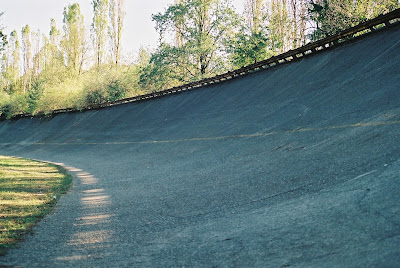
So as soon as someone says Ferrari, Monza and "are you in?" in the same sentence you can't help but simply say "hell yeah!". Fast forward to a rainy Saturday morning with not so chilly temperatures, the autostrada towards Milan was more crowded then predicted, and the rain was only getting worse. Of course the next day the weather was going to be wonderful, but we didn't know that... We arrived at the track, parked the car and as soon as the door was barely open, you could already hear the music of racing engines of various ethnicities clearing their throats. Another plus to the Monza race track is that it has a park all around it, meaning there are empty fields of grass and tall wild tries from hundreds of years ago as the frame to this picture. The track has been here for the good part of the last 92 years, and the funny thing is that a few years ago residents from the nearby houses were up in arms against the "noise pollution" of the racing track. Now, I'm not exactly the right person to question what is the right level of noise a race car should produce, but my opinion in this debate is actually very simple: unless you're 95 years old and have been living here for the last 95 of them, the track stays and so the race cars. If you moved here even just 30 or 10 years ago, you knew full well what you were going to face any given Sunday (another movie reference, at least this time it's not Micheal Bay...). Eventually they managed to put a limit to the maximum days permitted to "non complying cars", also known as damn-F1-cars. F1 cars which just got relatively quieter thanks to the new V6 Hybrid Turbo DRS ERS Whatever era, so I guess the party could be on full year now? Not with testing ban unfortunately.


Let's try to get back on topic.

The International Open GT championship is the kind of place where you'd find two kind of drivers and teams. Gentleman drivers living the dream and feeding their passion for racing and speed off their hopefully hard earned money, and official entries and drivers from major championships using these second tier events as training and probably a way to pay the bills as well.
When even the main GT championships are struggling to survive (cue, FIA GT1 and GT2 champhips) you get the picture. One could argue that if everyone could get their act together and put all eggs in a single basket we might get an awesome championship with a tremendously large field of cars. The thing is, you'd also get a tremendously different level of performance and speed on the track, with time gaps between the best and the worst cars/drivers measurable probably in something like a dozen of seconds per lap, at least. That's a potentially dangerous situation and would never work, but I think that having the same organization running something like 2 or 3 classes divided in the same number of races at the same location the same day could help. That's not a simple task either as indeed no one is thrilled by the mixture of the Daytona prototypes with Le Mans cars in the United SportsCars Championship in North America, but I know I love Le Mans and even the 24 Hours of the Nurburgring. Talk about performance differences there!
With the USCC they probably went a bit too far over there though, mixing something strictly American (the Daytona classes) with something imported from Europe (the late American Le Mans Series). I've no idea what they are trying to achieve, but we're never going to see a Daytona Protype at Le Mans any time soon, while only privateers could afford the ALMS. Heck, only privateers are running any endurance championship all around the world. The World Endurance Series itself is grabbing headlines only because of Audi and Toyota, but hopefully Porsche can add some competition and coverage as well, with others hopefully interested to come in. I don't consider Lotus a real factory entry as their name is actually Kodewa, running a modified Lola B12-80 car with a Judd engine, paying for the rights to use the Lotus banner. Kodewa being nothing else than the racing arm of one Colin Kolles, of HRT F1 team fame for most people out there. As with the HRT team, all of his recent efforts have been, let' say, sub par ("French" for "half-assed"), including the last two years running the LMP2 "Lotus", or the attempt to field two Audi R10 TDI in the European Le Mans Series in the past, everything seasoned with a constant lack of results. He seems to have the money, but not much else so far. I'm not thrilled by their motorcycle adventure either, once again called Lotus in the form of the CT-01. I actually hope Lotus come back to its sense soon and stop renting its name right away, Formula 1 team included. Let's call it Genii Racing, as it should. Once they got their name back, they could even think of releasing new cars again (not the Danny Bahar plethora of look-alike non-running concept cars perhaps).


End of the second off-topic diversion.

When I'm at a racing track I always lose any interest in what's happening on the track, who's fastest, who's first and the likes. I'm more interested in what's going on in the pits, the up-close action, the last minute checks on the cars, the pit-stops. Indeed following the action on the track is much more difficult when you're there. There is no on screen graphics to tell you the lap times or the drivers' order, and in GT and endurance racing, after a few laps the lapping starts and the cars on track start to mix, the slowest being in front of the fastest cars and you soon don't understand a thing about what's going on. Hearing the speaker and his live commentary is impossible, giant screen are cool but not very helpful, so you just sit back and enjoy the show, whatever it is. I eventually figured a long time ago that if you want to follow a race, you are better off at home with your super HD live feed eating taco chips or popcorn. If you want to experience the racing stuff, get yourself a pass from the paddock asap, especially for GT and endurance races.


It's even better if you can get in touch with someone within the teams, who can show you the cars, the tech and have a chat about the funniest or weirdest things that happened, it will be a blast and you won't care at all about who won. If that how you're going to feel, you'll want to do it again soon.
I've found out about it in 2004 when I bought myself a 2 days ticket for the FIA GT Championship for the Imola (Italy) round where Maserati debuted the MC12 GT1. I wasn't paying attention to racing stuff at all in those days, so I've found out about it only a couple of days before the race. Bought the ticket, took my father's minivan and off I was for the race track. I've slept in the car in the closest parking lot to the track, had lunches at the track, tried to talk with as many people as possible and even got to shake hands with Michael Bartels after his victory in the Saleen S7 GT1 of the Vitaphone team. Because that's how the atmosphere is at these races, relaxed and chilled. Aside for some uptight security guys and some high class families of the drivers, it looks like the hillclimb round of the national championship taking place just next to your house, just with cars 10 times cooler, faster and more expensive too.


I've no idea who won this time, but the Ferrari 458 GT were flying. Also, the Porsche 911 RSR (typ 996 of course) sounded as mean as usual, a different kind of noise compared to the earthquake like sound produced by the Chevrolet Corvette C6.R GT2, but still awesome. The McLaren MP4-12C GT3 though wasn't making much of a racing sound while fast moving from one corner to the next, but it was definitely trowing flames out of its exhaust downshifting. The Mercedes-Benz SLS AMG GT3 was producing the usual baritone sound as per AMG tradition. The Aston Martin V8 Vantage GT2 on the other hand was the unusual suspect, overlooked often in front of a lot of cars.


A car that caught my attention, mostly because I knew it already but wasn't expecting to see it, was the Montecarlo GT W12, debuting in the International GT Open that very weekend in Monza. Running on LPG (as in liquefied propane gas), it was developed by the Italian-Monegasque owner and driver Fulvio Maria Ballabio working together with the LPG and methane injection system builder BRC from Cuneo (Italy), using an Audi A8 sourced W12 6 liter engine, usually running on petrol. It was slower than any other GT3 car, but I'm glad it was there. Diversity, experimenting, driving and racing for the sake of it and not just to grab headlines and to reach F1 status is what makes these events so awesome. You could say it's not worth the hassle if you're not going to even be there to try and grab a place on the podium, but I bet you'd change your mind after 10 minutes with these guys.
Even better, if you got the chance to work with them, in any team!
If you are there just to win, you're doing it wrong, and you're not a real enthusiast. Of course winning is nice, but I consider it as the icing on the cake. You never turn down a cake even if it doesn't have icing, right?


Now a technical bit of information. Differences between the GT2 and the GT3 cars? Well, without taking out the rule book, it sort of comes down to this.
A GT2 car has a single restricted air intake, indeed as you can see in the pictures, the Ferrari 458 Italia GT has a completely different air box compared to the road going variant, with a pretty restricting minimum intake manifold diameter and the obvious very long Venturi-like pipe to try and recover some pressure. Without entering annoying engineering calculations leaving Bernoulli alone, in the smallest diameter of the air intake, the pressure is converted into speed. Once the sonic condition of the fluid (air) speed in it is achieved, no matter what you try there is not way to increase the volume of air entering the intake in a given time frame. If you can recover some of that pressure, you might add a bit of air entering the cylinders. More air means more fuel, which means more power. Of course adding fuel without air is not going to help much. So that's how an air restriction works.
GT2 cars thought have completely new and purpose-designed and built suspensions to tackle the track, more aggressive rubber on the wheels (different in size) and a stripped down weight. GT3 cars have larger air intakes (you can see the GT3 airbox is divided in two as on the road going Ferrari 459 Italia) so more power. The rear wing is also larger and positioned higher facing a much cleaner air flow in all likely. You could therefore expect more downforce. The GT3 cars though are not as light as GT2 cars and the suspensions are the same of the road going 458 Italia. Both cars run racing brakes, but the GT2 got better ones.


All in all the GT3 are obviously slower and less extreme to handle than GT2 cars, without costing just as much tanks to more stock components. A simple formula that is doing great as GT3-spec championships are on the rise all around the world. Of course when a manufacturer comes into the picture with a car designed with no limits in mind and then limited to GT3 specs (looking at you, Audi R8 LMS), the costs consideration can get out of the window, but you'll never face half million euros GT3 cars, that's the price for GT2 cars. An unrestricted Audi R8 LMS can compete against a GT2  specs Porsche 911 RSR as seen a few years ago at the Nurburgring 24 Hours when Audi entered the picture.
I honestly can't wait for the ACO, FIA and USSC to get their act together and promote even better the GT3 rule book, perhaps entering them in the WEC and Le Mans. Would be great.

Also running, single-seaters from the Formula ACI CSAI Abarth. One thing I noticed about those, the drivers were so young they probably didn't have a driving license... or shouldn't have one. But that's probably just me playing the grumpy old man, or being jealous of their father's money. Probably.


Thanks again to Manfro and the AF Corse guys for yet another great racing day.


All Watermarked Pictures and Words Copyright: Damiano Garro for The Italian Junkyard, other pictures courtesy of WikiMedia
This article can be linked to from other websites but its content and the pictures can't be reproduced on any other website without my written permission 

Want to know more?