

How many times did you hear the sentence “the last Pagani Zonda edition”? I bet you are thinking “way too many”, and you’re right, you heard that a lot, but it’s not as bad as you might think.
It probably started in 2009 when the Zonda Cinque and the Zonda R were unveiled in Geneva, even because rumors and some sort of official confirmations regarding a new model from Pagani called C9 were swirling around as well. That wasn’t the case though, as a year later we were staring at the Zonda Tricolore and Zonda Cinque Roadster, once again in Geneva. Not considering bespoke models and upgrades for various customers, in 2012 the Zonda R Evolution prototype appeared on the map at the Goodwood Festival of Speed. It was a monstrous evolution of the sleek yet wild Zonda R from 3 years earlier, even if the Huayra was kind of stealing the show.


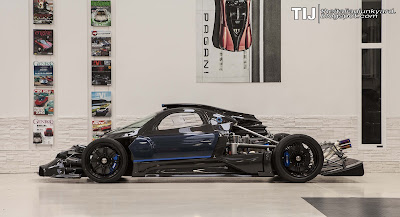
By the end of 2012 the Zonda 760 series was making headlines again. They couldn’t help themselves… By June 2013 the new Zonda Revoluciòn was unleashed, redefining the idea of a raw track car and reestablishing a worthy power gap between the road going Zonda 760 and its evil twin, now boosting 800 bhp, 50 bhp more than the Zonda R, and that's from a naturally aspirated V12 engine with a 6 liters capacity. Talk about power density...


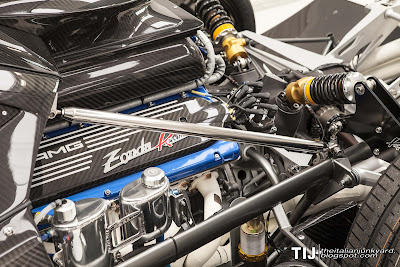
This specific car, the number #5-5 of the scheduled 5 units production run, finished with a clear coated carbon fiber in both natural and blue shades, is going to be showcased in Geneva 2014. Is it going to be the last new Zonda to cast its downforce on the road/track? Do you really care? Because if you ask me, there is no such thing as too many (new or upgraded) Zondas. There is actually one more road going Zonda with some bespoke elements looming in the shadow…


Now I understand when people complain about a car being long in the tooth, and I just had this feeling reading about the new Aston Martin V8 Vantage N430. Because it isn’t new, and it doesn’t look new either. It’s basically the same car unveiled 9 years ago. Refinished, polished, upgraded and so on, but it’s showing its true colors already, and I used to like it, I probably still do.
I was pleased with the 2012 Vanquish, which looked new despite surely carrying over some elements from the DBS/DB9 family, but for once the styling was refreshed and not simply tweaked. Notwithstanding the gorgeous One-77, Aston needed a new course to follow and the Vanquish seemed to have provided that, but then they simply updated the DB9 for the fourth (4th, seriously) time basically admitting the Virage was nice and everything but kind of pointless.
Now the Vantage family, both the V8 and V12 models, are putting Aston Martin in the same place it was in 2009 basically. They really need new models. I have the feeling the changes in ownership and the way too long talks with Daimler about the technology sharing agreement can be considered at least partially responsible for this, but now they really need to get their acts together, asap.


Why this digression? Because this is not the case with Pagani. Indeed here the matter is quite different. They did manage to pull the Huayra out of its development in 2011, releasing the production model in 2012, so enthusiasts and customers had their new hyper-rocket to talk and brag about. What they also did was to let customers keep on enjoying the Zonda as much as they wanted. It surely shows some self-confidence about the Huayra as they apparently weren’t scared of one car eating off sales/attention from the other.
Indeed Pagani customers are famous for being repeat offenders owning more than one Zonda, so there definitely was and still is room for a Huayra in their garages for sure. It seems a customer already got two Huayras in Switzerland too. More than that this move of preserving the Zonda shows that customers still love the car and just want more and more.


I thought the idea of the Revoluciòn was a bit farfetched as the Zonda R itself was battling against giants like the Ferrari FXX and FXX Evoluzione, the Maserati MC12 Versione Corse (with its racing pedigree too), the Ferrari 599XX and 599XX Evo, and other less adored offerings like the Mercedes-Benz SLR McLaren 722 GT or the Gumpert Apollo R to name a few. So I wondered if there was indeed room for another version, even if in just 5 units. Well apparently they did their math right at Pagani. 3 cars have already been spotted: the #1/5 finished in clear coated carbon fiber with yellow, white and red stripes which can be seen at the Pagani Atelier from time to time, the #2/5 finished in matte carbon fiber with gold, white and red stripes and then this black and blue beast. If these shots are anything to go by, you’d guess the 5th Revoluciòn is going to Japan, but it wouldn’t be the first time.

Should read something along the lines of: "HAPPY NEW YEAR!", but in Chinese. Full disclosure, Japanese people also use Chinese characters, maybe because Chinese has something like 100 times more characters than Japanese, just guessing here.

The 2nd Revolucion was delivered to Japan in June 2013 for its official local presentation and the launch of the Huayra in Japan as well. Indeed the black and carbon fiber Huayra you see here is the 15th produced car, chassis number 76016 if my chaps over the Pagani Zonda Forum did they homework properly. You can also see the Zonda F 24 of 25 in the background, rumored to be chassis number 76092. The Revoluciòn #2/5 was soon dispatched to Hong Kong though as basically something like a quarter or a fifth of all produced Zondas (some were then moved to mainland China).


A bit of technical data and specifications.
Its 800 bhp V12 AMG engine is an evolution of the same V12 found in the Zonda R 5 years ago, which was itself an evolution of the racing engine installed in the dominant and all-conquering Mercedes-Benz CLK GTR AMG from 1997. The torque has its peak at 730 Nm at an undisclosed rpm, but thanks to the feather weight of 1.070 kg the car is going to simply fly on the tarmac.
The gearbox is built out magnesium for a lightweight yet strong casing. It’s not the usual flappy-paddles actuated manual gearbox, this is a true sequential racing gearbox, but there still is an actuation mechanism so that the gears are selected via paddles rather than the usual lever, but you have to understand that there is a solid difference between a manual gearbox and a sequential gearbox, they are simply built and designed differently. As far as I know only the Ascari A10, the BAC Mono and the aforementioned Gumpert Apollo used real sequential gearboxes, all other road going cars use actuated manual gearboxes except for the Joss JP1 from Australia which uses a Zero Shift gearbox, which is another type of mechanism. The unit is disposed transversally, even if my instinct would have led me to say it was a longitudinal unit judging solely by pictures. It is a very short unit indeed.
A truly new addition to the car is the DRS, or drag reduction system, installed on the rear wing. As with Formula 1 cars, the device is meant to reduce drag generated by the tail of the car when downforce is not required. Indeed the system can either be operated manually pushing the properly labeled DRS button on the steering wheel or in automatic mode, moving the rear wing from the minimum downforce setup to its maximum downforce position when a lateral acceleration in excess of 0.8g in both directions is detected, at speeds over 100 km/h. As a reference, most sportscars can only dream to reach a 0.8 lateral acceleration, while for the Zonda Revoluciòn this is right where the game starts!

New breaks from Brembo dubbed CCMR (carbo-ceramic matrix – racing, I guess) are installed for a better track experience. They should be more powerful than the R discs, as if it was needed, and their lower operational temperatures extend the life of the discs by 4 times while also being 15% lighter and just as fading resistant.


The only bad news is that dreams are free but exquisite cars come at a price, 2.2 Million Euros plus taxes. That’s 700.000 € more than the Zonda R, but I’m pretty sure that after trying this beast on the track there would be no logical arguments keeping your piggy bank safe from the Zonda Revoluciòn.

Official Press Release:

Article by Damiano Garro for The Italian Junkayard Want to know more?


.jpg)
.jpg)
.jpg)
.jpg)
.jpg)
.jpg)
.jpg)
.jpg)

 Posts
Posts



