The Italian Junkyard

Thoughts, ideas, criticism about cars. Interesting news and facts from the world of the automobile. Events in Italy and Modena. What you can find elsewhere, filtered through the eyes of a discerning enthusiast. Design, style, everything on the chopping block. Nobody is safe anymore.

Showing posts with label Agera. Show all posts

Monday, March 14, 2011

20.3 More Is Never Enough: Last Addition to Koenigsegg's Line-Up Is Just Insane, perfect way to end an interview


So you thought that was it? No way, a new addition to the Agera’s family has just been parked in my extremely virtual garage.

Incidentally, I asked for a white Agera, and Koenigsegg released images of their new car in a bespoke white paintjob. Unfortunately, that’s not my car. Life can be tough…
This, my friends, is the new Koenigsegg Agera R.

Keeping with the company’s tradition, the “R” suffix means the car is capable of running on biofuel, which once again means an embarrassing amount of power at your disposal, if the “standard” 900 bhp Agera wasn’t enough for you.

Make the jump to keep reading, enjoy the rest of the high resolution official gallery and download the extensive press release, which I must say it's quite interesting for once.


Featuring chassis #83, this car wears a custom paint job which extends also to the interior, with red accents and some parts in exposed carbon fiber. I know you ‘d probably agree the most evident new feature is actually the additional cargo volume. Yes, that’s not a photoshop, and yes, it’s an official option, called the Winter Pack.
If you think about Koenigsegg, the fact it’s based in Sweden and how much snow you’re just thinking about, that makes sense, if you really want to go skiing and your snow plow is currently being serviced at the local garage.

There is actually so much more to talk about the production versions of the Agera and Agera R that it’s probably simpler for you to read the admittedly interesting press release. I’ll summarize the most striking features:

- New engine design allows for a BMEP (break mean effective pressure) of 28/30 bar, depending on your model, obtained also through a new combustion chamber design, new block which uses cylinders’ sleeves to improves its stiffness, new connecting rods, new intake and exhausts manifolds to improve airflow dynamics.

- Previous point translated for non engineer human beings: 900/110 bhp, 1.000 Nm of torque over a 2.500 rpm range, or 1.250 Nm for 3.300 rpm on the Agera R, 310 grams of CO2 in the EU homologation cycle, 14,7 km per liter.

- New 7 speed actuated manual gearbox, much lighter than a standard dual clutch unit at 81 kg.

- 70 kg carbon fiber chassis, including the integrated fuel tanks, and 65.000 Nm/degree of torsional stiffness. Dry weight setting a new benchmark at 1.330 kg, curb weight at 1.418 kg (all fluids plus half tank of fuel).

- “Rear Triplex Damper” suspension, for improved comfort and driving precision, which you can also spot trough the opening on the engine bonnet.

- New tires and vortex generating wheels, each of them specifically forged and machined to achieve this aerodynamics feature.

- Top speed limited (seriously) to 375 km/h, with possibility to engage a “full speed mode” through the infotainment system, given the car is in the right conditions, and so the track you’re about to face.

- Dynamic rear wing, which modifies its angle according to the speed to reduce drag, while also creating an effect very similar to a diffuser extracting hot air from the engine bay through the two pillar.

- Winter pack (yes, you read that right): custom made roof box by Thule, integrated into a second roof for a top speed of up to 300 km/h. In the same package you also get a vacation at Åre’s skiing resort, the most exclusive place for skiing in Sweden. Good deal, isn't it?

- Lithium Iron cells battery, enabling also new energy saving strategies specifically for when the car is left unused for long periods of time.

So the car is ridiculously fast and incredibly high-tech, but it still manages to maintain that old-school supercar air. Like they used to be: the danger, the thrill, and that feeling that came from knowing that the car is trying to kill you at every sharp turn, minus the killing part.

Once again credits to Mr Koenigsegg and his staff for the brief interview he gave us and the precious material they managed to provide us. Looking forward to talk again, and perhaps meet you at the next autoshow.

Thank you, The Italian Junkyard.


CLICK HERE TO DOWNLOAD THE OFFICIAL PRESS RELEASE (PDF):
2011 Koenigsegg Agera R #83 press release


All Pictures Copyright: Koenigsegg Automotive AB
Want to know more?

Saturday, March 5, 2011

20.2 Theory of Evolution: the interview with Christian Von Koenigsegg goes on


Europe is a nice small continent, but there is much more to be seen out there, which is the reason why the Koenigsegg CCX was introduced in 2006. Contrarily to what many think, this is a new car and not just a revised CCR. Unlike the preceding models, the shape of the car was the result of 3D CAD programs and all the tooling necessary for its production were created according to the results gathered from those programs. Just to further underline how the two cars are different, not a single body panel can be exchanged between the two.

Make the jump to enjoy some exclusive live images and read the rest of the story about Koenigsegg's supercars.


At the same time the CCX is homologated also for the North American market, which required new passive safety solutions, and also features a new engine. You could still say that’s the old Ford V8, tuned and polished, but you’d be mistaken, as this new unit it’s not only much more powerful but also gifted with many new solutions, and is now assembled at Koenigsegg’s headquarters. A new lighter block is produced in England, and other Koenigsegg-designed components are added. The only way you could still connect this engine to Ford is that probably you could fit one in a Mustang, if that makes any sense to you anyway.


The chassis was also enlarged, allowing for a roomier interior, and a new high-tech electric system was adopted. Last but not least, it was the first supercar to ever pass the new European pedestrian impact testing. Just in case you are staring at the car in the middle of the road…

One of the main variations of the CCX is the CCXR model, capable of running also on biofuel. Some of you may be happy to hear such an extreme supercar having an eco-friendly approach. I prefer to consider that gave the car an additional 200 bhp though. The specific specimen pictured here at Geneva 2010 autoshow was purposefully made for the supercar dealer Platinuss from Brazil, and it’s capable of running on pure biofuel.


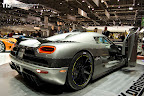
And then time came for the Agera. First unveiled in Geneva 2010, we already covered its debut last year and now you can enjoy a few more exclusive live pictures we took in Geneva during the autoshow. Keep in mind this was a pre-production prototype. It’s slicker and more aggressive than any other CCX special edition to date, yet very familiar. Regardless of the apparent similarities, this car shares only 20% of its component with the CCX. Being longer and wider, with a new front track and a new bodywork, this according to Mr K is a larger leap than between the CC8S and the CCR. The Agera has a new gearbox, the engine is still made by Koenigsegg but it’s a new unit, the suspensions were modified and tweaked, new and more powerful brakes were adopted, also updating the ABS and the tires. New interior fittings were adopted and a new air conditioning system was installed. Of course the new bodywork gave the car also new aerodynamic features.


Mr Koenigsegg recognizes that a much more dramatic change in the bodywork would have helped people identifying the new cars as, you know, a “new” car. At the same time his approach is more similar to the one adopted by another car company, much more famous and much larger:

“However, my design philosophy is that of the Porsche 911. Even if the 997 is technically very different from a 993, to the untrained eye the look very similar when passing by on the road. Still the 997 is a very capable and modern car. The philosophy is to only change what needs to be upgraded in order to maximize function, handling, performance and compliance, nothing else. Especially important to avoid trends as the cars should be as timeless as possible.”

I hope this is enough to teach all of you on how another supercar came to see the light of the day: one man’s commitment and ideas, but most of all, passion.


Mr Koenigsegg, thank you for your supercar company.

Now, if we could find an arrangement for that white Agera I was talking about…


All Pictures Copyright: Damiano Garro and Sarajane Bradshaw for The Italian Junkyard
Koenigsegg CCX pictures: Koenigsegg Automotive AB.
Want to know more?

20.1 Sweden Ain’t That Cold: Christian Von Koenigsegg gives us a quick interview on how he made his dream come true


A few months ago I found a Swedish website reportedly explaining how the Koenigsegg automotive company started life back in the nineties. After posting a link and some of the images in the Pagani forum I’ve already mentioned about and where I’m a moderator, everything seemed just fine.

It wasn’t.

About two weeks ago, Mr Christian Von Koenigsegg himself wrote me an email informing me that wasn’t exactly how things went. Now if you think about it, it’s weird enough that a company founder and CEO would take the time to contact a random guy to check on what he wrote about the company. It’s even weirder when such company produces cars so expensive that 99% of those who will read what that random guy wrote, won’t even be capable of ever buying such a car.

Click past the jump to know what happened over 10 years ago in Sweden...

Being an engineer myself, I’ve noticed far too many times that companies are often much too focused on sales and market shares rather than on their own products and image. Meaning that BMW is delivering ugly fat cars only because that’s what the market wants, regardless of what BMW may or may not be capable of producing and let alone paying attention to how many future customers they are losing.
I’m pretty sure BMW, did its calculations right, figuring not only they’ll manage to sell a lot of X6 SAVs now but also in the future, yet I won’t be buying any of their cars anytime soon, assuming money is not a setback.

At the same time, it’s my personal opinion that Ferrari isn’t paying enough attention to its fan base, avoiding official commitment to small and local events even though they are not only capable of affording the attendance fee, but probably of sponsoring the whole event. Granted, it is unlikely for them to hook a potential customer at these smaller venues, but they have surely lost out on the surefire sales of Ferrari accessories and extra gadgets that make up their large merchandising business.
Then again if a small and exclusive company like Pagani basically shows up at every possible event in Italy, not getting even just 1 € back, I guess everybody else can.
And this is specifically my point here chaps.

You produce hyper exotics cars in a cold country up there in northern Europe, your name is very famous among true enthusiasts yet there are people who have yet to figure how to pronounce it, and the speed of your car is only surpassed by the rate of which my bank account will dry up at the moment of purchase. Yet, you contact this Mr Junkyard person in Italy, to make a point your car company is nothing less than a dream come true and that you and only a handful of friends are responsible for it.

Mr Koenigsegg, you just got my respect. We’ll talk about my bright white Agera in a few decades though.

So back to the reason why I’m telling you this, Mr K (can I call you that?) started his company back in 1994, way before any of us could get a glimpse of that egg shaped whitish rocket. The foggy website reportedly mentioned one man named Svenharry Åkesson, who was responsible for the design of the first prototype, later purchased by Koenigsegg. The car was going to be named Sethera Falcon, and was featuring a tubular steel chassis.


It actually was the other way around. Mr Koenigsegg already designed the first CC model, on paper in 1994, and a 1:5 model was built by himself and friend David Crafoord. Subsequently Mr Åkesson was commissioned to build a full scale model, still based on Mr K’s design and on his behalf. You can even see what looks like a 1:10 model in the background, based on the original design. That was 1995.


Eventually Mr K and his team took over the full scale model, modifying it according to the original idea and to the evolution that the CC was already undergoing in his creator’s mind.
The steel chassis featured in that article was eventually purchased by Koenigsegg himself, that’s correct, but it was never used in any car. To put it to some use, this steel chassis was eventually used as a support structure for a full scale clay model.


Just one year later, in 1996 the full scale model was used to create the tooling to produce the very first CC drivable prototype, tested by Rickard Rydell as you can see in this picture. The chassis was once again designed by Mr Koenigsegg himself and by Dag Bölenius. A very similar second prototype was built and painted black. The whole project was still completely developed in-house.


A prototype was produced but things weren’t ready yet. In order to improve the overall project, they built a new full scale clay model with improved aerodynamics and design, specifically referring to the height of the tail, roof air intake, new headlights and more importantly the targa roof itself. Managing to fit the hardtop in the front compartment was a major challenge, especially because this time the roof was made out of one single piece of carbon fiber, while another car with a similar feature, the Porsche Carrera GT, went for a 3-piece roof solution. Eventually, the new CC prototype was still capable of 120 liters of luggage volume, the largest available on any supercar according to the factory.


If that doesn’t sound impressive, think about the Veyron Grand Sport and its glass roof which you must leave at home in lieu of an umbrella. The Koenigsegg sounds downright luxurious in comparison, regardless of how large the boot is on the Veyron, which I couldn’t find. I’ve added a couple of pics for comparison, judge by yourself which is the supercar capable of grand touring weekends…
Once this model was readied in 1997, they started making models of each part, and building the tools for them. At the same time they were developing the chassis and the new suspensions, between 1996 and 1999. During this process the 180° 12 cylinders was scrapped in favor of a V8 which was based on an engine from the Ford modular family, albeit heavily modified, with dry sump lubrication, stronger internals and that marvelous thing called supercharging.


Eventually, it took until the year 2000 to have the Koenigsegg CC ready for its maiden debut at the Paris Autoshow, and another 2 years were necessary to gain the European certifications. In this time frame, the car was tested in extreme environments and on various race tracks, while also undertaking the mandatory crash tests. Yes, supercars are crash tested as well. It’s painful but necessary.


This led to the first customer car, the CC8S in 2002:


Two year later in 2004 the CC8S evolved into the CCR. Among various technical updates, the CCR got new brakes, shock absorbers, a redesigned interior and bodywork, and more power thanks to a modified supercharging system. The chassis was still the same and proved to be up to the task giving Koenigsegg the official speed record for production cars in 2005, with a top speed of 388,87 km/h clocked on the Italian test track in Nardò.


Stay tuned to know what happened next, part 2 is coming soon!


All Pictures Copyright: Koenigsegg Automotive AB
Special Thanks to Christian Von Koenigsegg and Josephine Winger-Lang for the rare pictures they provided me.
Want to know more?