Showing posts with label carbon fiber. Show all posts
Monday, June 23, 2014
2014 Vanishing Point: Pagani Zonda LM, bespoke endurance racing at its finest
With the introduction in June last year of the already featured Zonda Revoluciòn, something more needed to be done on the road going side of the Zonda world. The Zonda itself takes its roots back to the good old Group C days, an era of monstrous prototypes that could spank Formula 1 cars, with the added bonus of being raced at the world famous 24 Hours of Le Mans. The only racing effort of a Pagani car, and a completely unofficial one, saw a Zonda race car, called the Zonda GR, enter at Sebring and Le Mans in 2003, with very little success, and giving it a try again at the 2004 Le Mans test days, only to retire from the actual event because of a crash during a test at the Vallelunga race track prior to the race. To this day, the Zonda GR is still raced in Eastern Europe with somewhat decent results, finished in a green and black livery. Little is left from the original 2003/2004 version.
Here it is at Sebring 2003, Le Mans 2003, Le Mans Test days 2004 and at Hockenheim about 10 days ago.
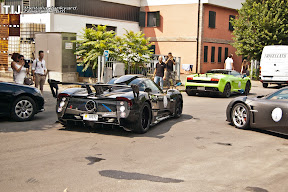
So while Pagani was always adamant there were no racing intentions for the Zonda, race cars always offered inspiration. One might say the Zonda 760 RS was quite enough of a road going race car, as one Lewis Hamilton might say referring to his own Zonda LH, but apparently there is at least one customer that wanted something more. Take the Zonda 760 series and it monstrous 760+ BHP engine, 7 speed actuated gearbox and revised aero, add a stronger Le Mans flavor, build a completely new and so far bespoke front end almost directly taken from the Revoluciòn, a modified rear end plus a new massive wing, new headlights and some other bits and bites, and you get the brand new Pagani Zonda LM. LM obviously standing for Le Mans. Another good name would have been Zonda Monstrous Beast edition, or even the Pagani "I want one now" Zonda. You get it.
The car was already spotted in Andorra where its registered and at Pagani factory of course, but it was yet to completed in all its details. Now the customer can fully enjoy his new ultimate Zonda in all its glory, and what best occasion than a private rally around Italy with other customers and Pagani entourage? Added bonus, this is the 10th anniversary of the first Vanishing Point Pagani meeting, and it's probably still ongoing right now as I write.
Full disclosure, I said the event is private, indeed only customers, partners and friends are invited. While taking pictures outside of Pagani headquarter, I noticed people coming and going from the showroom, people clearly not part of the event and not invited. So I walked in, wondering if indeed it was OK. No one seem to bother, so I took a couple of shots of the blue Pagani Huayra #001, the first production car. A few seconds later, I was kindly shown the door. I felt so bad for it, so let me post my apologies here in public, my bad.
As you can see the front of the car is modeled after Le Mans prototypes, perhaps those from the more recent years rather than those pointy ends on the cars from the 80s and 90s. The new headlights are a complete departure from the usual Pagani design, with now all four elements under a single cover reminiscent once again of LM prototypes. A new LED DRL element is visible too. While I think the new front ads some freshness to the Zonda profile and nicely integrates in it, there is quite some gap between the front clam and the cockpit/windshield, but perhaps that was done on purpose for ventilation reasons, indeed you can spot two massive radiator fans underneath it. Autofocus played a fast one on me this time and I didn’t notice at first, an almost useless picture is the result.
As for the other major modifications, the rear end was adapted, rather than built from scratch as the overall design seems quite the same, to integrate a lower spoiler and additional tail lights quite similar to those found in the Zonda R and Revoluciòn, this time though they feature a built-in spoiler too. The main wing is massive, even more than the 760 series and mimicking that from the Revoluciòn cars, but this time the side planes/pillars have a more complex design. Maybe it’s the less homogenous feture of the car, but not something I’d call a deal breaker for sure. As for the interior, it seemed pretty much standard issue, except for the chrome finish of the metal plaques, something else I’d rather do without.
The thing is, this car is the result of the dedication of Pagani to provide customers and the automotive world with yet another gem, and a customer willing to get his dream car completely tailored according to his liking. Apparently he also owns the Zonda Cinque Roadster #1/5 also featured at the gathering and a Zonda R too. I might add that some Zonda Rs are presently being updated to Revoluciòn specs, for good measure.
Even if the result may or may not be our first choice, we should be simply happy that there are people out there willing to commission, and to build, such bespoke and extreme creations. The same goes for the ever growing Ferrari Special Projects program, some of their cars are awesome, other less so, but it’s simply exciting that they exist. So now you just have to go out and make some millions, no more excuses separating you from your ultimate supercar!
I also feel like Italian companies are better at building such special cars, something to do with the heritage, racing history and Mediterranean passion for all things wild and personal. I don’t see Porsche pulling out such bespoke and exotic models. Mercedes have been building unique versions of their cars for some very loyal and wealthy customers, but most of the time we are talking about special version of existing cars, with maybe a different engine, or transmission (those fifteen E 55 AMG 4-Matic W210 anyone?) or refurbished internals (the eleven or so 300 SL rebuilt with modern suspensions, engines, steering, etc).
The raw nature of Koenigsegg’s cars allow for some additional madness to be infused by a willing customer, and the One:1 program is a great example of what more can be done, but maybe their product is so extremely designed to reduce the margin for modifications. I’d expect the aerodynamics on the Agera to be pretty much the best they could come up with for those outstanding top speeds, but a new balance may be found nonetheless.
Bugatti has shown already that all they are willing to do is a new set of wheels and body finish, but maybe McLaren can prove me wrong with some additional bespoke models after the somewhat weird but fascinating X1 Concept from 2012. Also the new Special Operations division of Jaguar might be in for some suprises. Last year Project 7 Concept was very promising, although the death of the C-X75 program is hard to justify in my mind. That was one sexy supercar.
Some other pictures of the event and the 2014 Terra di Motori with the 100th Anniversary of Maserati and a Pagani Zonda Revoluciòn will follow soon.
All Watermarked Pictures and Words Copyright: Damiano Garro for The Italian Junkyard
Other shots copyright: Guy Golsteyn, Ultimatecarpage.com, Belgian-Motorsport.com
This article can be linked to from other websites but its content and the pictures can't be reproduced on any other website without my written permission Want to know more?
Etichette:
carbon fiber,
endurance,
Le Mans,
Modena,
one-off,
Pagani,
San Cesario sul Panaro,
unique,
Vanishing Point,
Zonda
Monday, February 17, 2014
2014 Modena Antiquaria and Unica fair, Pagani Huayra P1, Transformers 4 edition
From time to time, you may happen to see an extraordinary car on the road, something you’d have never considered seeing. When I was a kid, it only took a Lamborghini Diablo to make my day, or rather the whole week.
It’s a bit different now, and that’s mostly because the Internet took over the world with all its pictures, videos, reviews, live feeds and whatnot. A Lamborghini Murcielago is all of a sudden a much more common car, and not simply because it has been produced in greater numbers than the Diablo, but because we are more used to it than we were to the Diablo back in the days.
While this is definitely great news for those who like me can’t never get enough of these masterpieces, I reckon the kid in me misses a little of that magic feel when such cars were briefly spotted on the road on your way to the grocery shop. Don’t worry though, there are still cars that can make you jump around like a little kid no matter what.
First and foremost thanks to Miss Pramazzoni for inviting us to the event, and thanks to Miss Giulia for the nice talk and walk around the car. As usual with Pagani’s people, you always feel welcomed.
Definitely not the first time you have seen the Huayra, but isn’t it a beauty every time? The craftsmanship is topnotch, the now proverbial Pagani maniacal attention to detail is ubiquitous, the bodywork design is simply exciting, and the sight is a simply knee-jerking experience. Add to that a candy red finish with exposed carbon fiber and a quite stylish silver stripe, and we got a winner here.
If cars were like movies and a subtitle was required I can’t think of a better one than “I’m thy God”.
Movies… what about them? It appears this car will be featured in a top movie very soon. Giulia was lip tight about the title of the movie because of the ongoing deal with the production house and Pagani, but it wouldn’t take much to find out tons of pictures with this very car on the upcoming Transformers 4 movie sets. She didn’t say it, so dear Michael Bay don’t be mad at Pagani! The secret was already out there anyway.
I’ve never been much of a Transformer movies fan (but I have a soft spot for the original animated series), but for once I’m going to be interested on how the Huayra presence in a major picture is going to turn out.
It’s not by chance though that this is happening right now. The Huayra is Pagani’s way into the North American market and a movie might be the best way not to collect more orders probably, but rather to have the car a bit more known in other countries, the US more importantly. Despite a now 15 years history and the astonishing Zonda already in the books, there is still an awful lot of people not knowing what the Zonda and the Huayra are, who Pagani is and where they come from. Even in Modena people sometimes wonder what model of Ferrari this might be… I say madness!
Back to more practical things, it took 2 years to get the Huayra certified for the US, bureaucracy, crash tests and fine tuning for the emissions took an heavy toll on the company, technically and financially, but now California and Florida shores are in sight. Additional side markers, “smart” driver and passenger airbags and even larger rear view mirrors are just among the various bits that were required to have the Huayra certified for the US, but even if the American life of the Huayra is just beginning, it was well worth bothering.
This car though doesn’t belong to any Hollywood personality or NBA player. It’s a factory car which is now back in Italy after its filming duties are over. I couldn’t help but notice that it doesn’t carry a regular VIN though, as this car is based on the very first Pagani Huayra prototype, or VIN ZA9C900P1 if you are into that, although it has obviously been thoroughly restored and rebuilt according to the latest specifications of the production Huayra.
Add to that at least two bespoke details I could spot, which so far haven’t been seen on any customer car yet. The easier to notice is the side profile on the optional front spoiler, which adds a lot of aggressiveness as little as it might be. It may also have an influence on the aerodynamics of the car but it’s hard to say without any hard data. The second seems an even more functional element, and it is this small winglet right after the front wheel, probably installed to reduce the amount of debris hitting the gorgeous bodywork of the Huayra.
Obligatory mirror shot, as per the Pagani rulebook.
As an occasional lady passing by said, “it really looks like a leaf”. Well, it’s supposed to look like a woman’s eye, but you’ll be forgiven.
Bonus pictures from the lady's mobile phone:
All Pictures Copyright: Damiano Garro for The Italian Junkyard
This article can be linked to from other websites but its content and the pictures can't be reproduced on any other website without my written permission. Want to know more?
It’s a bit different now, and that’s mostly because the Internet took over the world with all its pictures, videos, reviews, live feeds and whatnot. A Lamborghini Murcielago is all of a sudden a much more common car, and not simply because it has been produced in greater numbers than the Diablo, but because we are more used to it than we were to the Diablo back in the days.
While this is definitely great news for those who like me can’t never get enough of these masterpieces, I reckon the kid in me misses a little of that magic feel when such cars were briefly spotted on the road on your way to the grocery shop. Don’t worry though, there are still cars that can make you jump around like a little kid no matter what.
Beware the almighty Huayra!
First and foremost thanks to Miss Pramazzoni for inviting us to the event, and thanks to Miss Giulia for the nice talk and walk around the car. As usual with Pagani’s people, you always feel welcomed.
Definitely not the first time you have seen the Huayra, but isn’t it a beauty every time? The craftsmanship is topnotch, the now proverbial Pagani maniacal attention to detail is ubiquitous, the bodywork design is simply exciting, and the sight is a simply knee-jerking experience. Add to that a candy red finish with exposed carbon fiber and a quite stylish silver stripe, and we got a winner here.
If cars were like movies and a subtitle was required I can’t think of a better one than “I’m thy God”.
Movies… what about them? It appears this car will be featured in a top movie very soon. Giulia was lip tight about the title of the movie because of the ongoing deal with the production house and Pagani, but it wouldn’t take much to find out tons of pictures with this very car on the upcoming Transformers 4 movie sets. She didn’t say it, so dear Michael Bay don’t be mad at Pagani! The secret was already out there anyway.
I’ve never been much of a Transformer movies fan (but I have a soft spot for the original animated series), but for once I’m going to be interested on how the Huayra presence in a major picture is going to turn out.
It’s not by chance though that this is happening right now. The Huayra is Pagani’s way into the North American market and a movie might be the best way not to collect more orders probably, but rather to have the car a bit more known in other countries, the US more importantly. Despite a now 15 years history and the astonishing Zonda already in the books, there is still an awful lot of people not knowing what the Zonda and the Huayra are, who Pagani is and where they come from. Even in Modena people sometimes wonder what model of Ferrari this might be… I say madness!
Back to more practical things, it took 2 years to get the Huayra certified for the US, bureaucracy, crash tests and fine tuning for the emissions took an heavy toll on the company, technically and financially, but now California and Florida shores are in sight. Additional side markers, “smart” driver and passenger airbags and even larger rear view mirrors are just among the various bits that were required to have the Huayra certified for the US, but even if the American life of the Huayra is just beginning, it was well worth bothering.
This car though doesn’t belong to any Hollywood personality or NBA player. It’s a factory car which is now back in Italy after its filming duties are over. I couldn’t help but notice that it doesn’t carry a regular VIN though, as this car is based on the very first Pagani Huayra prototype, or VIN ZA9C900P1 if you are into that, although it has obviously been thoroughly restored and rebuilt according to the latest specifications of the production Huayra.
Add to that at least two bespoke details I could spot, which so far haven’t been seen on any customer car yet. The easier to notice is the side profile on the optional front spoiler, which adds a lot of aggressiveness as little as it might be. It may also have an influence on the aerodynamics of the car but it’s hard to say without any hard data. The second seems an even more functional element, and it is this small winglet right after the front wheel, probably installed to reduce the amount of debris hitting the gorgeous bodywork of the Huayra.
Obligatory mirror shot, as per the Pagani rulebook.
As an occasional lady passing by said, “it really looks like a leaf”. Well, it’s supposed to look like a woman’s eye, but you’ll be forgiven.
Bonus pictures from the lady's mobile phone:
Working!
All Pictures Copyright: Damiano Garro for The Italian Junkyard
This article can be linked to from other websites but its content and the pictures can't be reproduced on any other website without my written permission. Want to know more?
Etichette:
Antiquaria,
carbon fiber,
Huayra,
Modena,
Pagani,
photoshoot,
review
Sunday, March 27, 2011
17.5 Get your hands dirty, assemble your own Zonda: an interview with Horacio Pagani, PART 4
Talking with Mr Pagani has been an honor and a very interesting experience, but it was his son Leonardo and their PR manager Miss Pramazzoni who explained us how the magic is run at Pagani’s, and how your Zonda comes to life. They also managed to transmit the passion and commitment which go into each car. We were particularly surprised by the level of knowledge and enthusiasm of Leonardo. You can really see he and his brother Christopher are an actual part of the company and don’t just sit in a corner waiting for the job to be done.
Make the jump and follow us during an imaginary assembly of a Zonda. Close your eyes, and perhaps it will look like it’s your Zonda!
As many of you may already know, plans have been long under way to build a new factory so that annual production could be increased from 15 or so cars to up to 30/40 cars. This building has already been acquired by the company some years ago, and is in the process of being reconverted accordingly to Pagani’s requirement. As you may have figured, the first Huayra units are already being assembled in the old factory, which we’ll be converted into a sort of spa resort for the venerable Zonda once the new building will be up and running.
When we visited the factory last summer, a bit less than 120 road going Zondas had already been built, not considering a few other cars such as the track-only 2004 Zonda Monza, two units of the racing 2003 Zonda GR (built on behalf of team Carsport, with no official involvement of Pagani Automobili Spa) and a handful units of the ferociously fast Zonda R. That’s good for about 13 cars built every year since 1999 when the Zonda was unveiled in Geneva. At first each car took about 9 months to be completed from scratch, while now we could appreciate how they became much faster at that, as between our visits in May and June the cars under assembly were not the same. Given the quality has increased over the year to an almost senseless level, while new variants and options were introduced, you really got to give them credits for their work. Quicker and better, what more could you want? No, cheaper supercars are not in the cars…
Everything starts in the smaller room of the factory. In this climate controlled environment a few skillful hands model the precious carbon fiber and carbo-titanium fabrics into parts of the car and its chassis. Each component is then ready to be vacuumed into special bags and put into the autoclaves (large ovens which can maintain high pressures and temperatures for hours). It’s really important that you get as much air vacuumed outside of those bags as possible, as it would dangerously affects the variations in temperature and pressure inside of the bag itself, damaging the carbon fiber part, with also the possibility of air being absorbed by the resin itself. Even if you use a vacuum pump, when dealing with complex parts it may not be an easy task. Back in the days though, Mr Pagani found an easy solution to this problem.
If you ever happened to see how a new road or a parking lot is built, you may have noticed a white, soft yet compact fabric positioned just underneath the concrete and asphalt layers, mainly to avoid roots and other sorts of vegetation to find their way through, rather than around. On a similar occasion, Mr Pagani thought about trying that white fabric as a way to get the air out of the bags even using parts with complicated geometries. The fabric is laid adherently to the carbon fiber part, so that when the bag stick to it because of the vacuum pump’s caused depression, air can still flow through the fabric’s fibers. A very simple and cost effective way to solve a tricky situation.
As we mentioned, once the part is ready it needs to be positioned into the autoclave, where it will stay for a time which depends on the component itself and the desired properties you want to get out of it. By this step though, a lot of pages have been written in a very special book. Each car built so far has its own book, and there every step of its production is reported next to the names of workers and what they did, when and how. Everything is written down, so that whenever something needs to be checked back, it’s all there. This increase the responsibility of those who work on the cars, as your name is there to testify you’re responsible for your work.
It indeed happened that while Leonardo Pagani was giving us this technical tour, Mr Horacio Pagani himself showed up into the production rooms, and right before we left for his office, everybody gathered around a carbon fiber sill, and none of them looked too happy about what was going on. What happened is that the bag failed while in the autoclave, obviously damaging the sill. So whoever handled that component before of that stage was there to try to figure what went wrong and why. We all know that something can go wrong with no given reason sometimes, but I found it sort of reassuring (ok, it wasn’t my car, still) that everyone felt in a way involved in this little accident.
Once your carbon fiber parts are taken out of the ovens, you can start the actual assembly of the car. The first step is to position the whole bodywork and chassis on a jig to check that everything is perfectly aligned and each part fits each other. The two jigs are positioned next to the autoclaves, in the third and largest room.
Then the parts are shipped to a trusted paint shop here in Modena where the paints are applied. Meanwhile AMG Mercedes ships an almighty custom developed M120 V12 engine completed with all the electronics, while a gearbox is made available by Cima, another company from Modena. The front and rear Chromium-Molybdenum steel subframes are prepared to accommodate all the wirings and the suspensions, made out of Avional, a special aluminum alloy developed for the aircraft industry. The tank is integrated in the rear bottom part of the chassis. The whole assembly is held in the first room, the one you access to directly from the showroom in acse you’ve already been there. The smaller climate controlled room is now at your right, while the larger room is straight ahead of you, just to give you a quick idea on the factory’s configuration. The whole production area is smaller than what you’re thinking, really.
Up to now, the car could still be either an LHD or an RHD car, and hypothetically it wouldn’t be a major task to convert a car to one or the other configuration even after the assembly is completed, given it was making economically sense that is. While the two subframes are completed and connected to the main tub, the interior is on its way right after the wiring is done. Then each part of the car is assembled from the gearbox and exhaust to the complete and finished bodywork. As soon as everything is properly fixed and checked the car is ready for a test drive and a fine tuning, also according to the owners requests. The fine tuning is either held in the main room or in the largest one, depending on what’s required and on the stage of assembly of other cars.
I remember the first time I was there as a visitor in 2008, I’ve read a sheet full of notes about a car which was there for servicing. I can remember something in particular: “reduce downforce”. Guess the owner wanted some more thrill.
Perhaps a bit too simple, but that’s how you get the job done. From some layers of carbon fiber to one of the most acclaimed supercars of the last decades.
This would also be all from the Pagani factory, hope you enjoyed our lengthy report and pictures. We can’t wait to check the Huayra in the flesh in a month or little more.
All Pictures Copyright: Damiano Garro and Sarajane Bradshaw for The Italian Junkyard
Want to know more?
Etichette:
2 Italian Cents,
carbon fiber,
Ceramic,
design,
engineering,
factory visit,
Gallery,
Huayra,
Interview,
Modena,
one-off,
Pagani,
photoshoot,
review,
style,
Zonda
Subscribe to:
Posts (Atom)