The Italian Junkyard

Thoughts, ideas, criticism about cars. Interesting news and facts from the world of the automobile. Events in Italy and Modena. What you can find elsewhere, filtered through the eyes of a discerning enthusiast. Design, style, everything on the chopping block. Nobody is safe anymore.

Showing posts with label unveiling. Show all posts

Wednesday, January 28, 2015

Stunning Red Head of humble horigins and her Blondie heir: 1959 Fiat 600 Viotti and 2014 Willys AW380 Viotti


Technically speaking, there is only the body color of this car, or the color of the leather of its pristine interior, to qualify it as a red head, or as a Rossa in Italian. Even if back in the sixties most relevant figures in the Italian automotive sector had already been working for several if not most companies and coachbuilders from the country, it would be at least far fetched to bring about some connection between this car and say Ferrari, just to carry on the red theme.

It's nonetheless a beauty, a little gem from the local evergreen automotive industry. I actually find that what qualifies Italy among the most famous countries in the world when it comes to cars, it's not just Ferrari, Lamborghini and all the other loud names in the business, but also the capability to give birth to such great cars regardless of their technical relevance to the world, their price, or their performance. Most coachbuilders from the past and present experimented with small cars, and not simply providing the design of the bodywork or some technical insight in their engineering. It was and still is about creating something unique, special, with a personality in some ways.


Obviously today the market is in a completely different situation. There is no point in calling in the ever present global crisis, as long as Mini can afford to sell a 2.700 € set of wheels on a 30.000 € or so stock Countryman (or simply as long as it sells the Countryman I might say) it is not a matter of money availability. Sure some people suffered the crisis, not going to argue that, but there are still quite some people who can afford to spend quite some cash on rather common and not so special cars. Targeting Mini buyers is quite simple and a bit on the generalist side of things, but you got the point.
What sells is the brand, and even more so the image connected to the brand. I happened to come across a man at the mall last week, dressed with expensive clothes and with a brand new pinkish-iPhone-something, which then walked over to his car. A dented VW Polo MK3/6N. Now I don't pretend everyone to be a car enthusiast, but I couldn't help but notice he was carrying around at least twice, or trice, the money in clothes and phone than what his car was worth. And he was just fine with it which is the most important thing I take.


So is there a place somewhere in a market overcrowded with generalist offerings, premium average cars and brands actually owned by the same conglomerate, for something bespoke and special such as a truly bespoke Fiat 500, or Mini? Simple and short answer, no.
Cars are definitely less "cool" than they were 50 years ago, they no longer represent freedom and independence, and they are often seen just as a mean of transportation, and expensive one because of fuel, insurance, taxes and servicing. It's an open secret that in a few decades cars will be used just as horses are used today. Sports, sporadic trips on the countryside, fairs and little else. We will be hovering over cities with individual egg-shaped pods connected among themselves to move us around as quickly and efficiently as possible, while giving us to have a relaxed conversation, read a book (or play some silly-saga game on our augmented reality visors) and probably have lunch too in the process. What a marvelous thing progress is.


I truly believe that, but at the same time, I feel more and more people not directly involved with progress are just embracing its side effects rather than be a part of it. With people "involved" I don't mean simply engineering, scientists and researchers all around the world, but also people simply interested in science and technological progress, up to date with what's going on. If you don't understand something, it's pretty easy to misuse it, and hi-tech devices casted in the furnaces of hell are no exception. Actually, I'm pretty sure my grand-grandmother would have been even harsher on smartphones and the likes. Luckily, my grandmother has been corrupted by an LCD television a while ago. Internet is still a mistery though.

While digressing is probably my best ability, the point is it's not very common to find such a car as this 1959 Fiat 600 Viotti. Built upon a rather common and simple car, the body of this coupe can compete at any concours d'elegance all around the world side by side by with much more expensive and famous names. An evidence to this is that a Viotti Fiat 600 was featured in the first aired episode of Chasing Classic Cars, one of the few modern "reality" shows worth watching, and probably the only one among those automotive-related. For a car collector from the States to be in love with this rare and quirky little car from italy, it must be something pretty special. Here is a clip from another episode.


The Snail...


Viotti itself is partially back as a coachbuilder with the recently unveiled Willys AW380, which does its best at transforming a Porsche Boxster/Cayman into a modern replica of the Alpine A108 that the Brazilian arm of Willys was licensed to build in the seventies. The scene of its unveiling was the rather disappointing and slowly dying Bologna Motor Show, now the only generalist auto show left in Italy after the demise of the Turin Auto Show in 2002 (the last exhibition being held two years earlier). How ironic that such a pivotal place for cars as Italy is left without a decent show of international relevance.
Viotti is also a design firm in the modern sense, providing engineering know-how and prototyping facilities for new experiments. Indeed, bonus points if you can recognize what they have been working on in the recent years, might as well cover that car as well...


All pictures copyrtight: Damiano Garro for The Italian Junkyard
Press images courtesy of Carrozzeria Viotti Torino Want to know more?

Monday, March 14, 2011

20.3 More Is Never Enough: Last Addition to Koenigsegg's Line-Up Is Just Insane, perfect way to end an interview


So you thought that was it? No way, a new addition to the Agera’s family has just been parked in my extremely virtual garage.

Incidentally, I asked for a white Agera, and Koenigsegg released images of their new car in a bespoke white paintjob. Unfortunately, that’s not my car. Life can be tough…
This, my friends, is the new Koenigsegg Agera R.

Keeping with the company’s tradition, the “R” suffix means the car is capable of running on biofuel, which once again means an embarrassing amount of power at your disposal, if the “standard” 900 bhp Agera wasn’t enough for you.

Make the jump to keep reading, enjoy the rest of the high resolution official gallery and download the extensive press release, which I must say it's quite interesting for once.


Featuring chassis #83, this car wears a custom paint job which extends also to the interior, with red accents and some parts in exposed carbon fiber. I know you ‘d probably agree the most evident new feature is actually the additional cargo volume. Yes, that’s not a photoshop, and yes, it’s an official option, called the Winter Pack.
If you think about Koenigsegg, the fact it’s based in Sweden and how much snow you’re just thinking about, that makes sense, if you really want to go skiing and your snow plow is currently being serviced at the local garage.

There is actually so much more to talk about the production versions of the Agera and Agera R that it’s probably simpler for you to read the admittedly interesting press release. I’ll summarize the most striking features:

- New engine design allows for a BMEP (break mean effective pressure) of 28/30 bar, depending on your model, obtained also through a new combustion chamber design, new block which uses cylinders’ sleeves to improves its stiffness, new connecting rods, new intake and exhausts manifolds to improve airflow dynamics.

- Previous point translated for non engineer human beings: 900/110 bhp, 1.000 Nm of torque over a 2.500 rpm range, or 1.250 Nm for 3.300 rpm on the Agera R, 310 grams of CO2 in the EU homologation cycle, 14,7 km per liter.

- New 7 speed actuated manual gearbox, much lighter than a standard dual clutch unit at 81 kg.

- 70 kg carbon fiber chassis, including the integrated fuel tanks, and 65.000 Nm/degree of torsional stiffness. Dry weight setting a new benchmark at 1.330 kg, curb weight at 1.418 kg (all fluids plus half tank of fuel).

- “Rear Triplex Damper” suspension, for improved comfort and driving precision, which you can also spot trough the opening on the engine bonnet.

- New tires and vortex generating wheels, each of them specifically forged and machined to achieve this aerodynamics feature.

- Top speed limited (seriously) to 375 km/h, with possibility to engage a “full speed mode” through the infotainment system, given the car is in the right conditions, and so the track you’re about to face.

- Dynamic rear wing, which modifies its angle according to the speed to reduce drag, while also creating an effect very similar to a diffuser extracting hot air from the engine bay through the two pillar.

- Winter pack (yes, you read that right): custom made roof box by Thule, integrated into a second roof for a top speed of up to 300 km/h. In the same package you also get a vacation at Åre’s skiing resort, the most exclusive place for skiing in Sweden. Good deal, isn't it?

- Lithium Iron cells battery, enabling also new energy saving strategies specifically for when the car is left unused for long periods of time.

So the car is ridiculously fast and incredibly high-tech, but it still manages to maintain that old-school supercar air. Like they used to be: the danger, the thrill, and that feeling that came from knowing that the car is trying to kill you at every sharp turn, minus the killing part.

Once again credits to Mr Koenigsegg and his staff for the brief interview he gave us and the precious material they managed to provide us. Looking forward to talk again, and perhaps meet you at the next autoshow.

Thank you, The Italian Junkyard.


CLICK HERE TO DOWNLOAD THE OFFICIAL PRESS RELEASE (PDF):
2011 Koenigsegg Agera R #83 press release


All Pictures Copyright: Koenigsegg Automotive AB
Want to know more?

Saturday, March 5, 2011

20.2 Theory of Evolution: the interview with Christian Von Koenigsegg goes on


Europe is a nice small continent, but there is much more to be seen out there, which is the reason why the Koenigsegg CCX was introduced in 2006. Contrarily to what many think, this is a new car and not just a revised CCR. Unlike the preceding models, the shape of the car was the result of 3D CAD programs and all the tooling necessary for its production were created according to the results gathered from those programs. Just to further underline how the two cars are different, not a single body panel can be exchanged between the two.

Make the jump to enjoy some exclusive live images and read the rest of the story about Koenigsegg's supercars.


At the same time the CCX is homologated also for the North American market, which required new passive safety solutions, and also features a new engine. You could still say that’s the old Ford V8, tuned and polished, but you’d be mistaken, as this new unit it’s not only much more powerful but also gifted with many new solutions, and is now assembled at Koenigsegg’s headquarters. A new lighter block is produced in England, and other Koenigsegg-designed components are added. The only way you could still connect this engine to Ford is that probably you could fit one in a Mustang, if that makes any sense to you anyway.


The chassis was also enlarged, allowing for a roomier interior, and a new high-tech electric system was adopted. Last but not least, it was the first supercar to ever pass the new European pedestrian impact testing. Just in case you are staring at the car in the middle of the road…

One of the main variations of the CCX is the CCXR model, capable of running also on biofuel. Some of you may be happy to hear such an extreme supercar having an eco-friendly approach. I prefer to consider that gave the car an additional 200 bhp though. The specific specimen pictured here at Geneva 2010 autoshow was purposefully made for the supercar dealer Platinuss from Brazil, and it’s capable of running on pure biofuel.


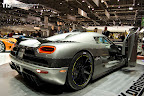
And then time came for the Agera. First unveiled in Geneva 2010, we already covered its debut last year and now you can enjoy a few more exclusive live pictures we took in Geneva during the autoshow. Keep in mind this was a pre-production prototype. It’s slicker and more aggressive than any other CCX special edition to date, yet very familiar. Regardless of the apparent similarities, this car shares only 20% of its component with the CCX. Being longer and wider, with a new front track and a new bodywork, this according to Mr K is a larger leap than between the CC8S and the CCR. The Agera has a new gearbox, the engine is still made by Koenigsegg but it’s a new unit, the suspensions were modified and tweaked, new and more powerful brakes were adopted, also updating the ABS and the tires. New interior fittings were adopted and a new air conditioning system was installed. Of course the new bodywork gave the car also new aerodynamic features.


Mr Koenigsegg recognizes that a much more dramatic change in the bodywork would have helped people identifying the new cars as, you know, a “new” car. At the same time his approach is more similar to the one adopted by another car company, much more famous and much larger:

“However, my design philosophy is that of the Porsche 911. Even if the 997 is technically very different from a 993, to the untrained eye the look very similar when passing by on the road. Still the 997 is a very capable and modern car. The philosophy is to only change what needs to be upgraded in order to maximize function, handling, performance and compliance, nothing else. Especially important to avoid trends as the cars should be as timeless as possible.”

I hope this is enough to teach all of you on how another supercar came to see the light of the day: one man’s commitment and ideas, but most of all, passion.


Mr Koenigsegg, thank you for your supercar company.

Now, if we could find an arrangement for that white Agera I was talking about…


All Pictures Copyright: Damiano Garro and Sarajane Bradshaw for The Italian Junkyard
Koenigsegg CCX pictures: Koenigsegg Automotive AB.
Want to know more?